

Why an 8-Bar Loop Never Becomes a Track
Your loop sounds good because it promises nothing. It states a fact: here is a kick, here is a bass, here is a chord. Nothing is owed to the listener, so nothing can disappoint them. A track works differently — it makes a promise and then pays it. Everything that holds a listener through seven minutes of trance is that promise-and-payment cycle, not the timbre of your supersaw.
So the problem isn’t that you lack arrangement knowledge. You can already name the sections. The problem is that you never designed an energy curve — a plan for where the listener should feel starved and where they should feel flooded. Without that plan, adding sections just makes a longer loop.
The Energy Curve: The Track’s Only Real Plan
At 138 BPM, one bar is about 1.74 seconds and 32 bars is about 56 seconds. That single number is your unit of planning: a section is roughly a minute, and a seven-minute club mix is around 240 bars. Write the map in bars before you write a note.
| Section | Bars | Length | Energy (0–10) |
|---|---|---|---|
| Intro | 1–32 | 32 | 2 |
| Build 1 | 33–64 | 32 | 4 |
| Drop 1 | 65–96 | 32 | 7 |
| Breakdown | 97–128 | 32 | 1 |
| Build-up | 129–144 | 16 | 2 → 8 |
| Main drop | 145–192 | 48 | 10 |
| Outro | 193–240 | 48 | 3 |
Two rules govern this table. There is exactly one peak — if drop 1 and the main drop are both at 10, neither is. And the lowest point of the track sits immediately before the highest point. The breakdown is not a rest stop; it is the price you pay to make bar 145 land.

Preparing the Drop Into the Breakdown: The Last 4 Bars
A breakdown is a controlled collapse, not a cut. If everything stops on the downbeat of bar 97, the listener hears a mistake rather than a descent. Work backwards from bar 96.
Pull the bassline out at bar 93 — a full bar of kick and percussion alone already signals that something is leaving. At bar 96, don’t let the kick run to the end of the bar: stop it after beat 3. That missing half bar is the sound of the floor opening.
Skip the crash on bar 97. A reverse cymbal rising across bar 96 into the downbeat does the same job without closing the door. And automate the reverb send on your lead or chord bus upward across bars 95–96, so that when the kick disappears there is an audible tail hanging in the room. The tail is only perceivable once the low end is gone; that’s the whole trick.
Inside the Breakdown: How to Fill 32 Bars
Split the 32 bars into four blocks of 8 and give each block one job.
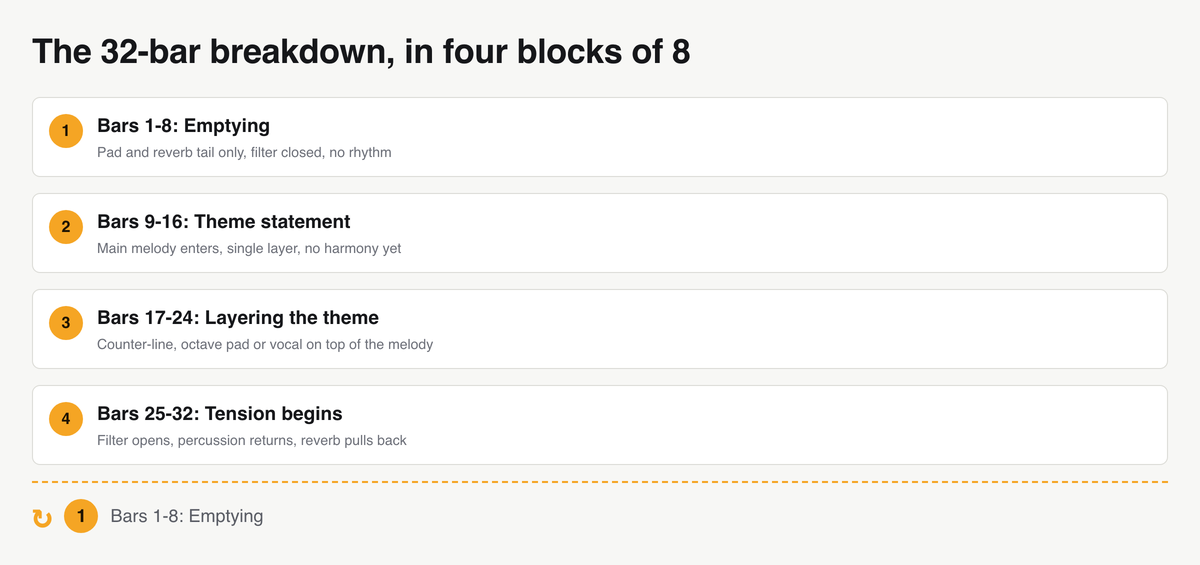
Introduce exactly one new element per 8-bar block. More than that and the breakdown becomes its own arrangement, competing with the drop it was supposed to set up.
The important decision is in block two: the main melody arrives at bar 9, not bar 1. Eight bars of pad and empty space make the listener lean in and start waiting. The melody then answers a question they already asked. If you open with the melody, it is just information.
Across all 32 bars, the pad’s filter cutoff and reverb amount are your tempo gauge. Start with the cutoff low and the reverb wide — distant, blurred. By bar 32 the cutoff should be open and the reverb noticeably drier, because a drying room pulls the sound toward the listener. That one pair of automation lanes carries more of the breakdown than any new sound you could add.
Breakdown length is a format decision, not a taste decision. 32 bars is the safe default for a club mix. 64 bars only works if you have a genuine second theme to state; without one, it is dead air on a dancefloor. Radio and streaming edits usually cut the other way — 16 bars, because the listener’s patience budget is shorter when no one is dancing.
The Build-Up: Six Tools That Build Tension in 16 Bars
Bars 129–144. Local bar numbers below:
- High-pass filter sweep — starts bar 1, moves slowly across all 16 bars. The longest gesture, so it starts first.
- Element reduction — bar 1: the sub bass goes. Bar 9: the pad’s low layer goes. Building tension is partly subtraction.
- White noise riser — enters bar 5, 12 bars long, volume automated upward.
- Reverb/delay send increase — from bar 9, raise the send on the lead until the dry signal is half-buried.
- Snare roll — bar 9 at 1/8, bar 13 at 1/16, bar 15 at 1/32. Each doubling is a new piece of information.
- Pitch riser — bar 11, roughly 6 bars long. The last and most aggressive gesture.
The staggering is the point. If all six start at bar 1 and all six end at bar 16, you don’t get a 16-bar increase in tension — you get 16 bars of constant noise, because nothing changes state along the way. Tension is perceived at the moment of change, so give the ear a new change roughly every four bars.
Designed risers and sampled risers both work, and they fail in different places. A sampled riser is fixed in length and key, so it fits when your build-up is a standard 8 or 16 bars and the track isn’t harmonically exposed at that moment. A riser you build yourself — noise through an automated filter, or a sawtooth with pitch automation — can be tuned to the track’s key and stretched to any odd length, which is what you need when the build-up is 12 bars or when the riser sits under an audible chord.
The Final Bar: Silence and the First Hit of the Drop
On the last 1–2 beats of bar 144, cut everything. No riser, no snare, no pad. That gap is not a stylistic flourish; it resets the ear’s reference level, so the first kick of bar 145 is measured against silence instead of against a wall of noise. Same kick, bigger perceived impact.
Two placement details decide whether it reads as intentional. The riser should end one sixteenth before the downbeat, not on it — a riser that collides with the kick smears the transient you just worked to expose. And the kick lands exactly on the bar 145 downbeat, no delay, no pickup. The gap is the suspense; the kick is the resolution.
One risk to name: playing the exact breakdown melody over the drop. It feels like a payoff but it isn’t — the listener already heard it, so the drop delivers nothing new and the energy reads lower than bar 128. Use the melody’s harmony with a different rhythm, drop it an octave, or hold it back for the second 16 bars of the drop.
Building It in Logic Pro: Markers, Automation and Bus Structure
Open an empty project and create arrangement markers first — Intro 32, Build 1 32, Drop 1 32, Breakdown 32, Build-Up 16, Main Drop 48, Outro 48. You now have a 240-bar skeleton with named, correctly sized sections and nothing in them. Logic’s arrangement track also lets you drag whole sections, which is how you test whether the breakdown should be 32 or 16 bars without re-editing regions.
Three bus decisions that keep the arrangement workable:
- One FX bus for all risers and sweeps. Transitions get mixed as a group, and you can duck the whole group against the drop with one automation lane.
- Breakdown reverb as a send, automated. Automating the send level rather than the plugin’s wet amount lets the same reverb serve the drop at a lower level.
- Section levels via bus faders, never the master. Grouping drums, bass, leads and pads to busses means “the breakdown is too loud” is one fader move, not twelve.
If you don’t already have this structure in place, build it once as a template rather than rebuilding it per track: Building a Trance Template in Logic Pro From Scratch.
Four Common Mistakes
A 64-bar breakdown with one theme. The listener stops waiting and starts checking how much time is left. Waiting only generates tension while something is still developing.
Building by addition only. If nothing leaves during the build-up, the drop has no headroom to be louder or wider — it arrives and sounds like more of the same.
A drop less dense than the breakdown. When the emotional peak is in the breakdown, the drop reads as an anticlimax and the track’s single peak lands in the wrong place.
The same riser at every transition. By the third occurrence it is no longer a signal, it is furniture, and the ear stops using it to predict what’s coming.
What to Do Next
Open the project with your 8-bar loop. Don’t add a sound. Place arrangement markers with the bar counts above, leave every section except your loop completely empty, and play the whole 240 bars start to finish in silence while watching the playhead. If the empty breakdown already feels too long sitting there, it will feel too long with a pad in it.
Only after the curve feels right do you go back to sound design. Before that, import a reference track you admire into the same project, line it up to the grid, and mark its section boundaries with markers of your own. You’ll learn more about where that producer put the lowest point than any tutorial can tell you.